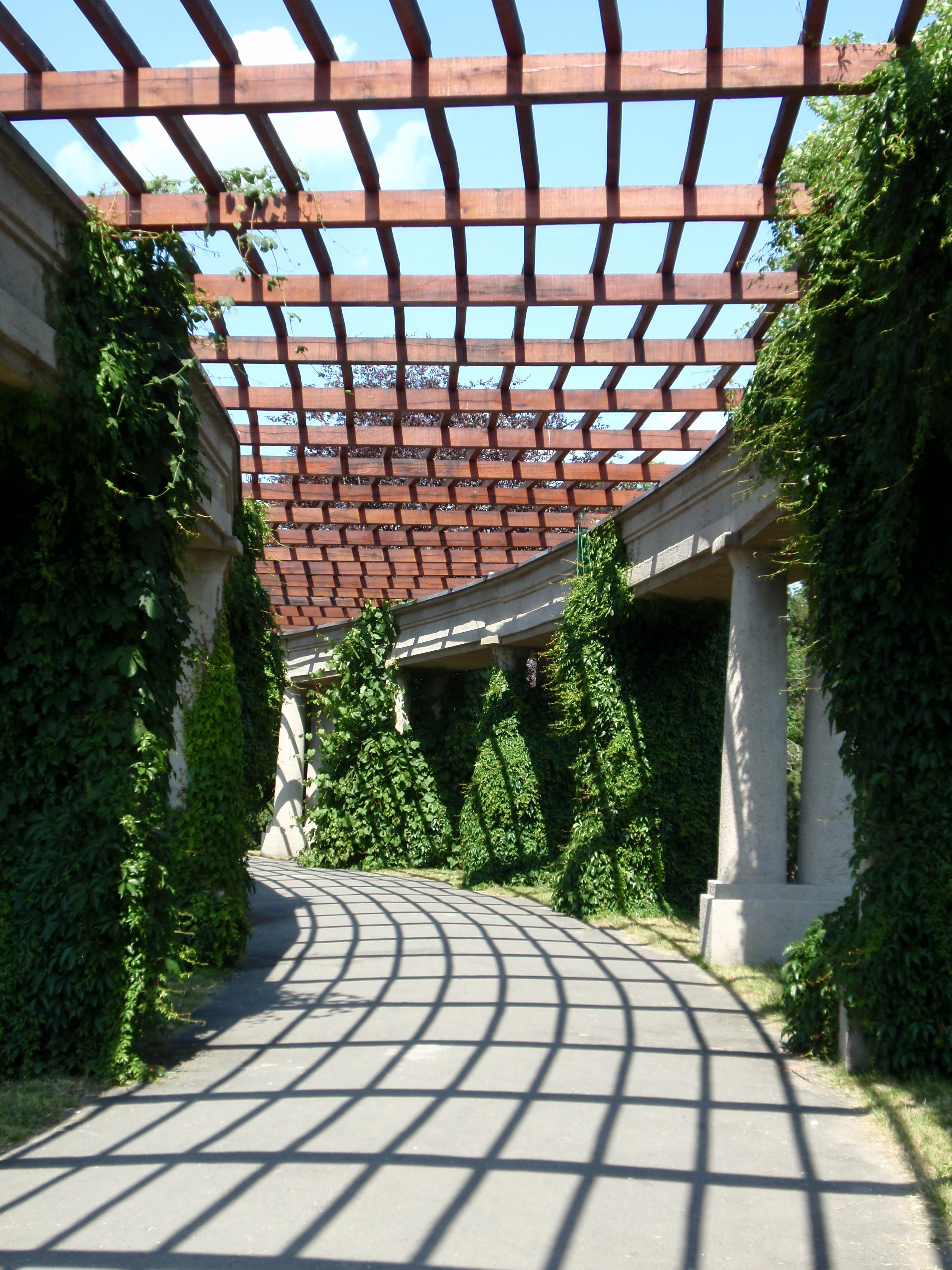
Pergola with summer foliage. Photo: Wikimedia Commons, CC BY-SA 3.0
What a Pergola Is — and Is Not
A pergola is an open-frame overhead structure — typically with posts, horizontal beams, and open or partially filled rafters — designed to define a space and provide partial shade. It differs from a gazebo in that it does not have a solid roof or full enclosure.
In Polish construction terminology, a pergola is generally classified as a temporary structure (budowla tymczasowa) when it is freestanding and not attached to a building. This classification typically places it below the threshold requiring a building permit, though local conditions may differ. An attached pergola that affects the building envelope may require a permit notification (zgłoszenie) at minimum.
Pergolas can be left open to the sky or fitted with shade elements: shade sails, polycarbonate panels, retractable awnings, or bioclimatic blades. Each option changes how the structure performs in rain and the extent to which it extends usable time outdoors.
Wood
Timber is the traditional pergola material and remains widely used in residential gardens in Poland. The main considerations:
Pine (Sosna)
Pressure-impregnated pine (drewno impregnowane) is the standard softwood for outdoor structures. The impregnation process — typically using copper-based salts — extends lifespan significantly compared to untreated pine. Structural sections for pergolas are available from building merchants throughout Poland.
Maintenance involves annual or biennial application of oil or stain to visible surfaces. Neglected pine darkens, cracks longitudinally, and eventually checks at exposed end-grain sections.
Thermowood
Heat-treated pine or ash — known commercially as thermowood or termowykno — has reduced moisture absorption due to the modification of cell structure during processing. It is more stable dimensionally than untreated pine and requires less frequent treatment: oiling every 2–3 years is typical for covered applications.
Thermowood has a distinctive warm brown colour that weathers to grey if left untreated. It is available from Polish suppliers, though at higher cost than standard impregnated pine.
Tropical Hardwood
Teak and bangkirai — the most commonly available tropical hardwoods for outdoor use in Polish retail — are dense, naturally oily timbers that resist moisture, insects, and fungal degradation. They require minimal maintenance compared to softwood options: oiling once every 2–3 years is sufficient for most applications.
Cost is substantially higher than domestic timber. Supply chains vary; FSC-certified product is available through some importers.
Wood creates the most natural-looking pergola and integrates well with established gardens, but requires consistent maintenance commitment. A neglected wooden pergola deteriorates visibly within a few seasons.
Steel
Steel pergola frames — typically from hot-dip galvanised sections, sometimes with powder coating — offer high structural rigidity at moderate cost. Steel allows for longer spans than timber at equivalent section sizes, which is relevant for larger pergola formats.
In Polish residential contexts, steel pergola kits are available from several manufacturers and garden centre chains. Quality varies considerably between mass-market products and bespoke fabrication.
The main maintenance concern with steel is surface treatment. Powder-coated steel resists corrosion well if the coating remains intact. Any mechanical damage to the coating — scratches, drilling for fixings — should be treated promptly with compatible touch-up paint to prevent rust formation.
Steel is heavier than aluminium. For freestanding structures without a concrete footing, this is a minor consideration; for roof-mounted or wall-attached applications, structural assessment of the fixing point applies.
Aluminium
Aluminium pergola systems — factory-extruded profiles, powder-coated — have become the dominant choice for bioclimatic pergolas (those with motorised rotating blades) and higher-end residential installations in Poland over the past decade.
| Property | Wood (Impreg. Pine) | Steel | Aluminium |
|---|---|---|---|
| Maintenance frequency | Annual oiling/stain | Inspect coating yearly | Minimal — occasional wash |
| Typical lifespan | 15–25 years (maintained) | 20–30 years | 30+ years |
| Weight | Moderate | Heavy | Light |
| Relative cost (frame only) | Low–moderate | Moderate | Higher |
| Visual character | Natural, warm | Industrial or minimal | Clean, contemporary |
Aluminium's key advantage over steel for outdoor use in Poland is that it does not rust — the anodised or powder-coated surface, if properly applied, requires no periodic anti-corrosion treatment. Cleaning with a soft cloth and mild detergent annually is sufficient for most installations.
The bioclimatic pergola category — aluminium frames with motorised rotating louvers (lamele) that open and close to control light and ventilation — is a growing segment of the Polish garden market. These structures sit at a higher price point but allow year-round sheltered use when paired with side screens.
Climbing Plants and Pergolas
One of the practical functions of a pergola is supporting climbing plants — wisteria (glicynia), climbing roses, clematis, or hops (chmiel). Plants add seasonal shade, visual interest, and in some cases fragrance.
For wooden pergolas, ensure that the structure is well-maintained beneath plant growth — moisture trapped between plant stems and wood accelerates decay. Stainless steel or galvanised wire supports reduce direct contact between stems and the structural timber.
Aluminium and steel pergolas are more forgiving under dense plant growth from a maintenance standpoint, as surface corrosion is less of a concern.
References
- GUNB — Main Office of Building Supervision — permit requirements for outdoor structures
- Building Research Institute (ITB) — technical publications